
Work & hobby meme pages
Build jokes around the small frustrations your community recognizes, such as an unfinished craft project or a group chat that will not stop.
Start with the joke your audience already understands. VidMage can create the setup image, a moving payoff, or a character reaction. Add your own caption and control when the punchline appears in your editor.
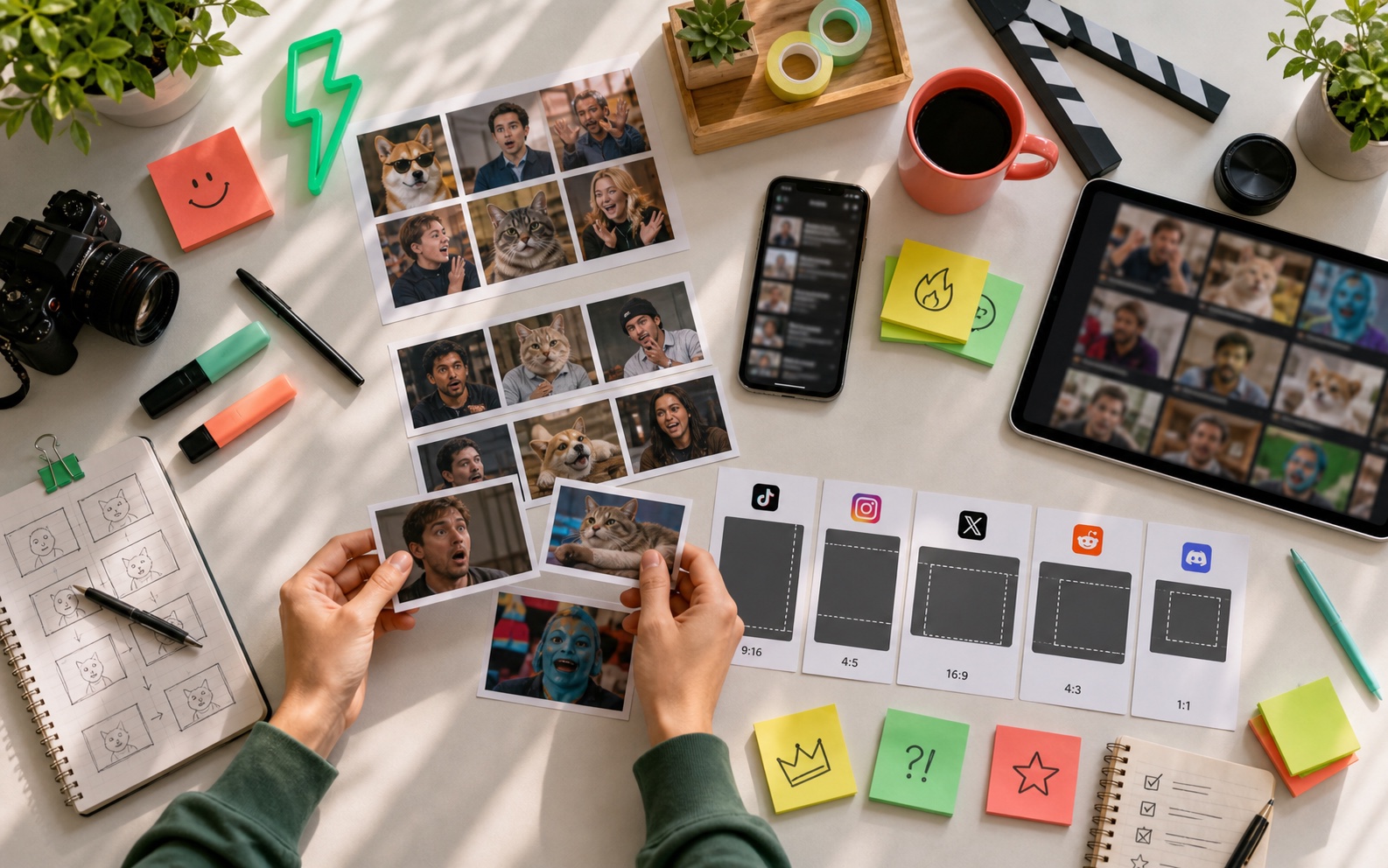
The audience recognizes the situation. Your job is to make the setup and the twist easy to read.
Build jokes around the small frustrations your community recognizes, such as an unfinished craft project or a group chat that will not stop.
Write the observation first, then choose a visual that makes it readable. Leave exact wording, line breaks, and font size for your design app.
Give your original character one expressive movement for a reply. Judge the first readable pose and the end of the reaction before trimming the clip.
Plan the setup and the moment the situation changes. Generate a single comic action and let the cut, sound, or caption deliver the payoff.
Show the contrast between expectation and reality or before and after. Decide which one detail should change so the audience can read the joke quickly.
Keep a list of recurring audience situations and original characters. Save the selected visual files with their caption ideas and notes for future posts.
Give a caption its setting, time a moving payoff, animate a reaction, or show a two-panel contrast.

Floating islands illustrate an exaggerated escape from an ordinary group chat.
Caption-led meme writers
Your caption is “The quiet place I need after one group chat.” Another reaction screenshot adds noise, but a calm, impossible setting would make the contrast clear without another line of explanation.
Describe an isolated fantasy setting in VidMage’s AI Image Generator, with one clear focal point and room for the caption. Add the exact sentence in your design app, then preview the image at feed size before choosing the final crop.
Make the visual serve the observation you wrote, with text placement that keeps the joke readable on a phone without explaining it twice.

A dramatic canyon leap accompanies “Me finally replying to the email I opened on Monday.”
Video joke makers
The joke is a tiny task treated like a heroic achievement. A still image shows the exaggeration, but the leap and landing need to happen before your punchline appears.
Ask VidMage’s Text to Video for one comic action, such as a small fox leaping a canyon. Watch where the action reads most clearly, then trim around that moment and add your task caption or sound cue in the editor.
Put the payoff at a deliberate point in the clip instead of asking the caption to carry both the setup and the action.

A felt rabbit stops knitting when the caption reveals another last-minute request.
Reaction image creators
Your page has a character image that followers recognize. For a reply to an unexpected message, you need a pause or glance, not a new scene with another subject and background.
Upload the character artwork to VidMage’s Image to Video and describe a small response, such as stopping an activity and looking up. Check for changes to the character, then trim the downloaded clip so the reaction starts promptly.
Reuse a recognizable source image for a focused response and keep the surrounding joke in your caption or comment rather than adding unnecessary action.

“One small weekend project” sits beside a bench covered in more unfinished pottery than the maker expected.
Comic & niche meme pages
Your pottery community jokes about a quick project becoming a week of unfinished work. The comparison needs a clean first panel and an exaggerated second panel, not two unrelated pictures.
Create the two scenes separately in VidMage’s AI Image Generator: one simple workbench, then the same stated setting crowded with unfinished pieces. Select a pair with readable contrast, arrange them in your design app, and add the two captions.
Show the escalation side by side so the audience can spot the difference before reading a long explanation of the situation.
Decide where the joke lives: in the caption, the action, the reaction, or the contrast between panels.
Write the short observation your audience will recognize. Choose one unexpected turn and remove details that do not help set it up.
Use a still for a caption-led joke, a clip for a moving payoff, a source image for a reaction, or two separate scenes for a panel comparison.
Create the assets in VidMage. Check whether the situation is readable before adding text, and reject distracting details that explain a different joke.
Download the selected files. Add exact wording, panel layout, timing, or sound in your editor, then view the post at the size your audience will see.
The same image tool can serve very different jobs. Choose based on the caption, action, or comparison you need.
| Part of the joke | Your input | VidMage tool | Output |
|---|---|---|---|
| Give a written observation its visual setup | Caption idea + scene with space for words | AI Image Generator | Still image for your exact caption |
| Time an exaggerated action as the payoff | One comic action + clear setting | Text to Video | Clip to trim around the punchline |
| Make an original character respond | Character artwork + one reaction | Image to Video | Brief response clip |
| Show escalation across two panels | Two descriptions that differ in one key detail | AI Image Generator | Pair of scenes for a labeled comparison |
| Try a different setting around your own artwork | Original image + requested scene change | Image to Image | Variation to inspect before reusing the character |
After downloading the visual, test the post with the final caption or sound. A moving payoff needs enough setup to make sense; a still meme needs text that can be read without hiding the subject. Remove extra words or action if they explain the joke twice.
Use your editor for exact typography, panel layout, sound cues, GIF conversion, and repeating playback.
Confirm that the intended subject and situation are recognizable at feed size.
Let the caption, audio cue, or panel change arrive where it adds the comic turn.
Preview once without the prompt in front of you. Remove any context the audience would have to guess.
Simplify the mechanism of the joke, then check the context and source material before publishing.
For a caption-led meme, write the observation first. Generate a setting that makes the contrast visible, then add the exact text in your design app. If the joke depends on motion, plan the action and the moment the caption appears together.
The prompt may include several twists competing for attention. Keep one familiar situation, one main subject, and one change that carries the joke. Review the result without text to see whether the intended setup is visible.
Find the first frame where the reaction is readable, then keep enough of the movement for the response to land. Trim a long lead-in or unrelated action. Set the final duration and repeat behavior in your editor.
Download the selected video clip and convert it in a compatible editor or GIF tool. Check file size, legibility, and the start-to-end transition there. A generated clip is not automatically a seamless repeating GIF.
Use one shared setting and change the detail that creates the contrast. Review the generated pair for unintended differences, then use a consistent crop and caption style in your design app. Keep the panel labels short.
Animation can change the face, pose, colors, or background. Compare the result with your source and select the version that still reads as your character. If the movement does not help the joke, use the original still instead.
Keep your original artwork and chosen reaction files in your own library. VidMage deletes uploaded and processed Web photos and videos within two hours. Uploads, prompts, and generated media are not used for AI model training.
Check file retention and privacyWrite the observation first. Build the still setup or the single reaction that helps the audience understand the joke.